
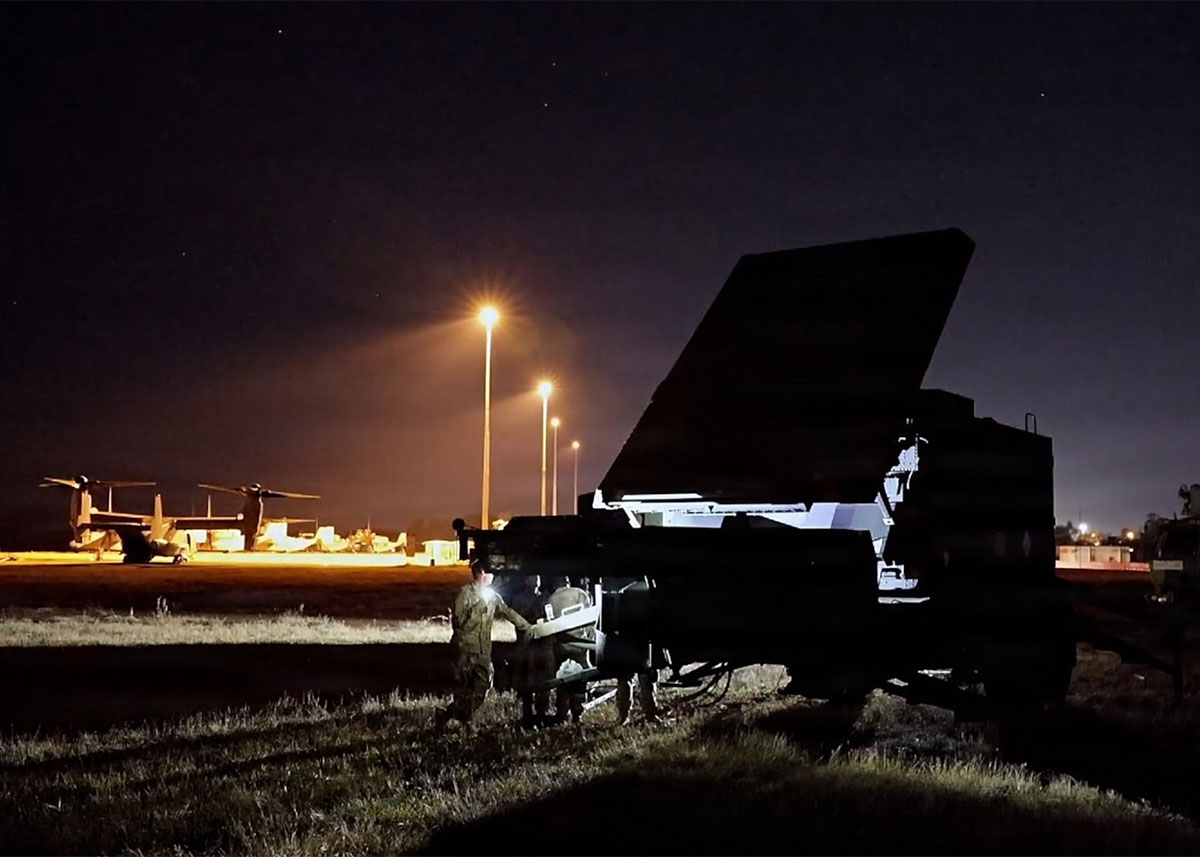
U.S. Army Soldiers from 1st Battalion, 1st Air Defense Artillery Regiment, 38th Air Defense Artillery Brigade emplace a Patriot radar system under night conditions, July 19, 2025. The Janus Program, the Army’s next-generation nuclear power program, aims to deliver secure, resilient, and reliable energy to support national defense installations and critical missions. (U.S. Army photo by Capt. Frank Spatt)
ANCHORAGE – As strategic competition accelerates across the circumpolar region, defense practitioners, allies and partners, and regional security scholars convened at the Ted Stevens Center for Arctic Security Studies on Joint Base Elmendorf-Richardson for an intensive workshop examining critical security challenges facing the Arctic theater.
The Advanced Microreactors Arctic Deployment Workshop brought together leaders from across the Department of War, interagency partners, international allies, and indigenous communities to bridge long-term strategic policy with immediate operational realities in the extreme cold.
Participants analyzed how rapid environmental shifts, evolving geostrategic dynamics, and increased adversary activity are redefining the operational environment from the North American Arctic to the High North. A central priority throughout the sessions was addressing persistent capability gaps in Arctic domain awareness, particularly across intelligence, surveillance, and reconnaissance assets, satellite communications, and navigational infrastructure.
Participants engaged in structured working groups and scenario-driven table discussions to determine how emerging technologies—ranging from uncrewed aerial and maritime systems to cold-weather sensor grids—can be effectively integrated into existing command architectures such as NORAD and U.S. Northern Command.
The dialogue continuously reinforced that Arctic security remains fundamentally a collective enterprise. Delegates from Arctic and NATO allied nations highlighted the necessity of cooperative defense alignment to ensure mutual support across the North American Arctic and European High North. Discussions focused heavily on operational readiness and lessons gleaned from recent joint winter exercises to enhance logistics sustainment, combat capability, and cold-weather medical response, while also emphasizing civil-military coordination and deep partnerships.
Unlike conventional academic curriculum, the workshop prioritized generating concrete, practitioner-focused recommendations for defense decision-makers to support warfighters.
As the Ted Stevens Center continues its mission to advance defense education, research, and partnerships, initiatives like this workshop reinforce or Nation’s enduring commitment to a secure, stable, and rules-based Arctic region.