
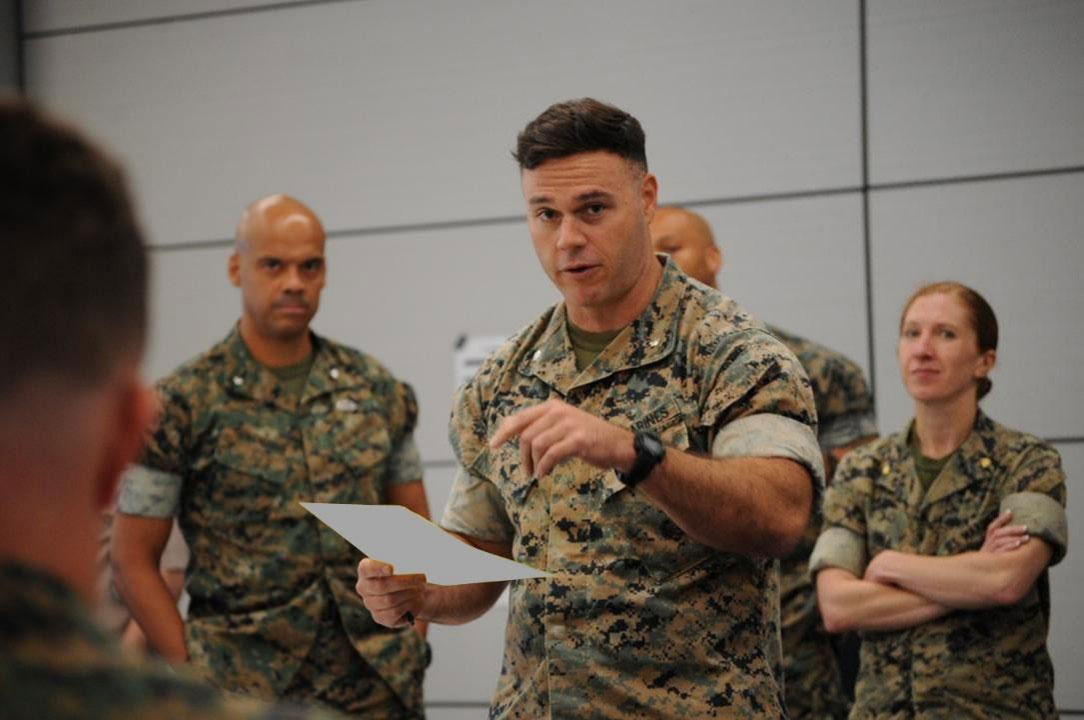
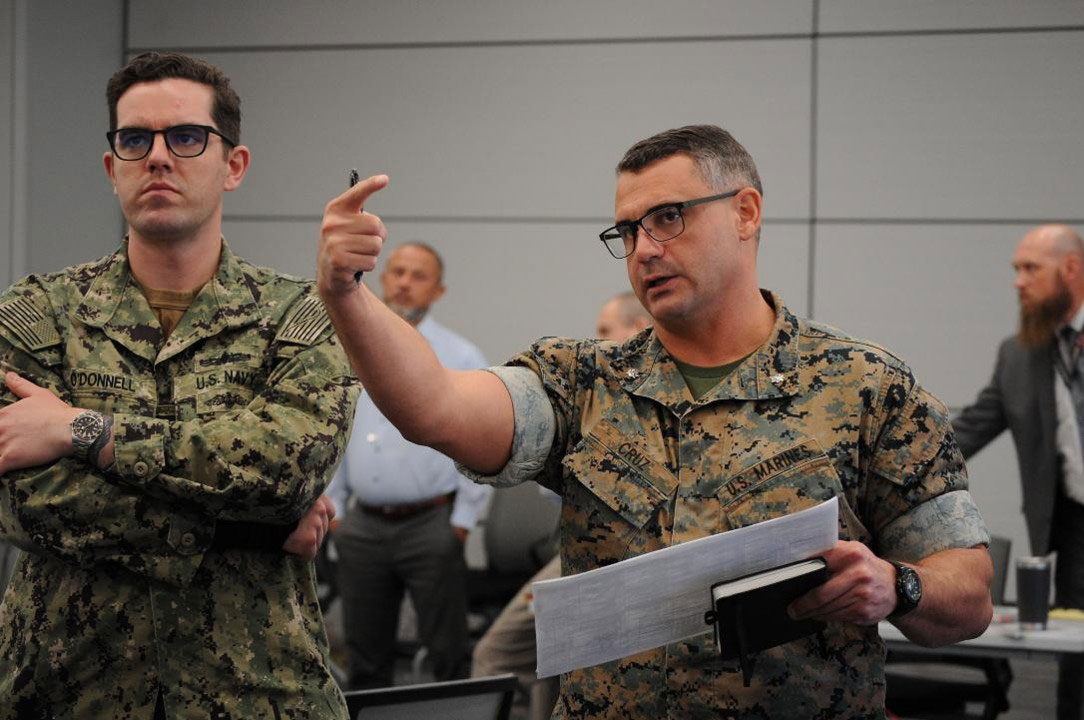
Photos courtesy of the Marine Corps Warfighting Laboratory
QUANTICO, Va. — As global competitors and their proxies advance all-domain counter-intervention strategies designed to complicate the deployment, employment, and sustainment of the Joint Force, Department of War planners are intensifying efforts to examine how service components will operate in contested future environments.
To address these emerging challenges, Ted Stevens Center for Arctic Security Studies Deputy Director Craig Fleener recently participated in an intensive five-day wargame hosted by the Marine Corps Warfighting Laboratory (MCWL). The event brought together senior military leadership, strategic analysts, and regional specialists to evaluate the Marine Corps’ recently published doctrine, First to Fight: A Capstone Operating Concept, within the framework of a joint campaign.
The wargame focused on testing the U.S. Marine Corps ability to conduct military and naval activities in coastal regions and shallow waters where open sea and land closely interface operations against sophisticated military challenges. Analysts examined doctrine operational tasks integrate into joint campaigns and worked to identify key multi-domain joint enablers—spanning logistics, communications, and intelligence—required to sustain operations under persistent adversary pressure.
With northern approaches and high-latitude operational environments gaining increased strategic prominence, the inclusion of dedicated Arctic expertise provided a critical dimension to the operational scenarios.
TSC’s participation drew strong praise from the MCWL Wargamining Division Director.U.S. Marine Corps Col. David Tran.
“Partnering with the Ted Stevens Center injected critical Arctic expertise into our wargaming,” said Col. Tran. “This collaboration directly sharpens our warfighting concepts, ensuring the Joint Force remains ready to operate and win in any clime and place, including the high latitudes.”
Deputy Director Fleener praised the high level of rigor and leadership present throughout the exercise.
“It was an exceptional and highly valuable exercise,” Fleener said. “These Marines truly represent the tip of the spear in operational and strategic analysis. Collaborating alongside a room filled with seasoned senior leaders who bring extensive operational experience added extraordinary depth and rigor to the entire evaluation.”
Fleener, a U.S. Marine Corps veteran, noted that the exercise underscored a substantial and growing demand across defense organizations for specialized regional insights. “We are running simultaneous events and there was lots of appreciation for an Arctic subject matter expert,” Fleener said. “We have been asked to be available for future engagements with the MCWL, including opportunities for expertise across the regional center enterprise.”
The engagement drew strong praise from TSC Director Maj. Gen. (Ret.) Randy “Church” Kee, who emphasized that supporting operational defense planners represents a core tenet of the organization’s founding mandate.
“I am super pleased that you have made a powerful impact with a community that provides hard defense,” Director Kee stated. “It matters and is a crucial reason why the Ted Stevens Center was formed. Providing Arctic expertise in such forums is a key point of our value to the Department of War.”
Insights generated during the week-long wargame are slated to inform ongoing doctrine development, force design evaluations, and joint warfighting integration. The positive reception of Arctic subject matter expertise is expected to open avenues for continued collaboration with MCWL and other Department of War regional centers as the Joint Force postures for future operating environments.