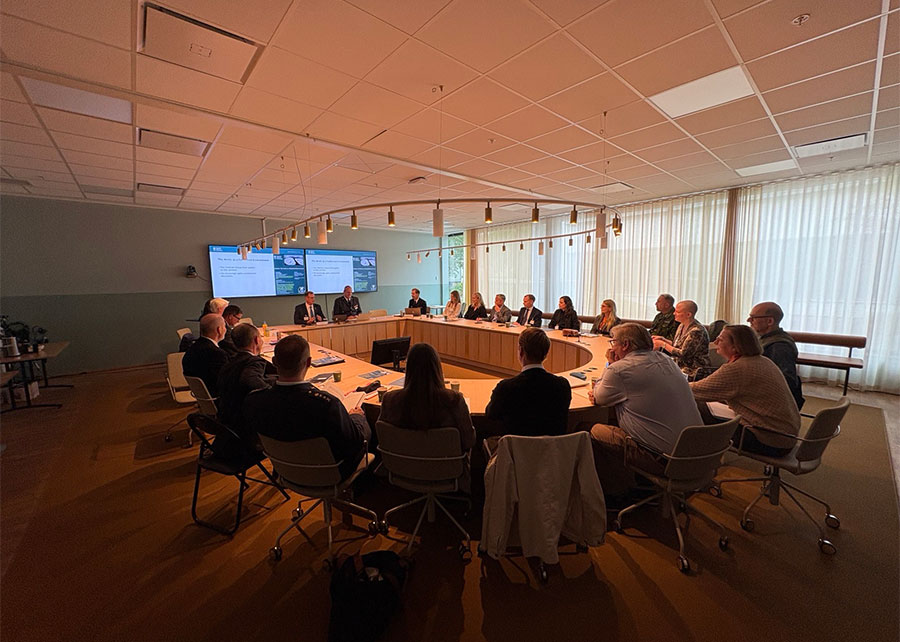
STOCKHOLM — Defense leaders, scholars, and practitioners from the United States, Sweden, and allied nations concluded a landmark educational dialogue in Stockholm this month, discussing allied operational readiness, and cooperation across the High North.
Hosted jointly by the Ted Stevens Center for Arctic Security Studies, the Swedish Defence University, and the Swedish Armed Forces, the two-day engagement highlighted the rapid operational integration of NATO’s newest Arctic ally into the collective defense architecture of the polar region. The dialogues brought together operational warfighters and academic experts to bridge high-level scholarship with frontline requirements, directly advancing our Nation’s priorities.
As shifting geophysical conditions and geostrategic friction reshape polar operating environments, participants emphasized that the Arctic cannot be treated as a monolithic theater. Rather, stark variations in geography, seasonal extremes, logistics infrastructure, and operational access demand close bilateral synchronization to match sovereign capabilities with collective alliance requirements.
In late September, Secretary of State Marco Rudio met with Arctic Allies in New York to reinforce the strategic imperative of sustained allied investment and coordination on shared challenges in the Arctic. During these meetings on September 21, U.S. State Department Spokesman Tommy Pigott stated that, “Allies agreed that Arctic security requires continued investment to safeguard this vital region and deter strategic competitors.”
The TSC’s work at the SEDU represents the implementation of that broader national mandate. As Washington reinforces the strategic imperative of securing critical access points and bolstering sovereign capabilities, the Ted Stevens Center assists the U.S. with infrastructure, cooperation, and operational readiness are fully prepared for future challenges.
To operationalize that mandate, the working groups evaluated operational lessons learned from recent northern exercises, worked to develop common operating frameworks, and assessed the resilience of the transatlantic defense industrial base.
Among the outcomes of the Stockholm engagement was a mutual commitment between the Stevens Center and Swedish defense counterparts to explore designing future courses, creating a lasting pipeline for allied tactical and operational education.
While discussions explored the operational impact of emerging technologies such as artificial intelligence and quantum systems, participants repeatedly emphasized that cutting-edge systems cannot replace the human foundation of northern warfare. Much of the Arctic continues to lack the resilient energy, transportation, and communications infrastructure common to lower latitudes, making local environmental literacy, seasoned judgment, and physical resilience indispensable.
That sentiment resonated strongly with regional partners, including attendees from the Nordic Defence Cooperation. NORDEFCO representatives praised the dialogue for clarifying the multifaceted demands of Arctic security, with one participant remarking that the sessions provided the exact foundation needed to better understand what research and analysis to complete to support Arctic operations. Delegates concluded that Arctic regional knowledge represents a vital strategic asset—one that requires a whole-of-government approach and rests upon an enduring cultural baseline of institutional trust.
The momentum generated in Stockholm reflects a broader surge in allied educational engagement, coming directly on the heels of the Ted Stevens Center’s third iteration of its flagship NATO in the North Course. The three-day, 12-hour intensive curriculum analyzed the Alliance’s evolving northern footprint amid Russia’s war against Ukraine, increasing Chinese regional interest, and the historic accession of Finland and Sweden to NATO.
Demonstrating practical burden-sharing, the course was conducted in close partnership with Norway’s NATO Centre of Excellence for Cold Weather Operations, an institutional collaboration that grew out of a reciprocal visit to the Stevens Center in August 2024. The latest iteration convened more than 70 practitioners and national security leaders across 11 allied nations using a hybrid and expeditionary model that blended live virtual plenaries with distributed, in-person breakout sessions, including a dedicated cohort of U.S. Air Force Special Operations personnel participating out of Langley Air Force Base in Virginia.
“I especially valued the sessions on the Arctic operational environment, NATO and Allied deterrence and defense, and capability requirements and interoperability. The emphasis on cold-weather readiness, sustainment, resilient communications, multinational [Command and Control], and the human dimension helped connect strategic concepts to real operational problems.” remarked a participant of the course. Keynote speaker General (Ret.) Christopher Cavoli, former Supreme Allied Commander Europe and Commander of U.S. European Command, urged graduates to serve as operational catalysts within their home commands to spread shared understanding of High North security. Paul Dodge, Director for Arctic Policy in the Office of the Under Secretary of War for Policy at the Pentagon, provided closing remarks reinforcing Washington’s commitment to allied polar readiness. Course graduates will sustain their operational collaboration through a newly established NATO in the North Community of Interest.
High North Security dialogue between the U.S. and Sweden continues to gather pace. Swedish Defence Attaché Maj. Gen. Rikard Askstedt recently led a delegation of Washington-accredited foreign defense attachés to the Ted Stevens Center, reinforcing academic and operational ties. That dialogue will continue next month when Swedish defense officials and allied leaders convene in Alaska for the annual Anchorage Security and Defense Dialogue, scheduled for October 27–29 in Anchorage.