
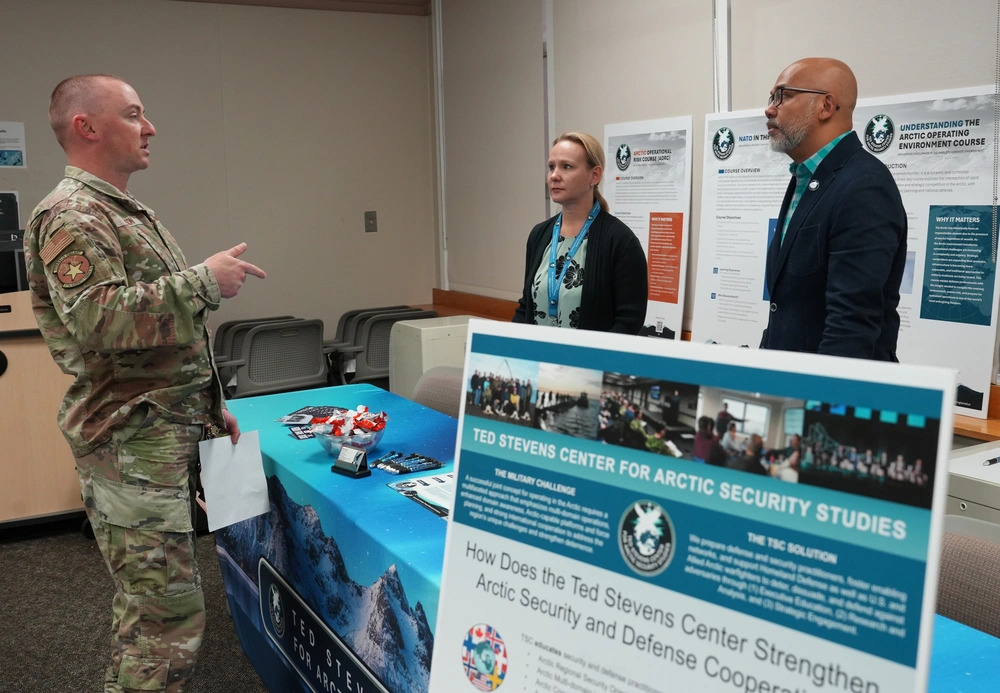
As the Department of War intensifies its focus on homeland defense and rebuilding the nation’s military, one persistent challenge remains: retaining operational experience before it leaves the force. At the Ted Stevens Center for Arctic Security Studies, the DoW’s SkillBridge program has become a solution. By placing soon-to-retire warfighters directly into Arctic security–focused research, education, engagement, and mission support roles, the center is helping the department preserve decades of tactical knowledge critical to homeland defense in the Arctic region, where experience and judgment cannot be rapidly replaced.
“SkillBridge is a way for active-duty military to transition from their military service into their civilian careers, gaining experience with a government agency,” said Sabrina Collins, the TSC’s human resources specialist and SkillBridge program manager. “Although we’re providing skills for them to take on the outside of their military career, we’re also gaining the knowledge that they’ve had for 20-plus years, which is beneficial for both parties.”
The new SkillBridge certification allows the TSC to bring in service members from any branch for up to 180 days as they prepare for retirement or separation. Those participants work directly inside the center’s different divisions and functional areas. As Collins explained, “We’re open arms. Anyone who is interested in participating, we are willing to work with them to find the right fit.”
The program has grown rapidly. “We currently have three actively participating in the program and 13 projected to join us over the next year,” Collins said.
Interest, she added, surged the moment the center announced its involvement. “There are a lot of folks interested in the Arctic, our center, and Alaska.”
One requirement presents both a challenge and a benefit: SkillBridge participants must be physically present at the center for at least 50 percent of their program. Despite that hurdle, Collins said the center is able to arrange barracks accommodations when available and remains committed to finding solutions for applicants who want to relocate.
The center’s role as a Regional Center for the DoW means its SkillBridge work is directly tied to broader national defense objectives. As Collins noted, SkillBridge placements help reinvest operational experience back into federal service. “It can benefit the Department of War by retaining those skills they have acquired during their military career and continuing to use them in their civil service careers,” she said.
One of the first warfighters to join the TSC was Lt. Col. Matt “Froggy” Ketchie, an air battle manager assigned to 11th Air Force. After more than 23 years of service, including time as an E 3 AWACS mission crew commander and director of the commander’s action group at Alaskan Command, the Alaskan NORAD Region and 11th Air Force headquarters, he knew it was time to retire but not to walk away from the mission.
He also knew he wanted to stay in Alaska.
“I’ve tried my entire career to get to Alaska,” Ketchie said. “There’s a culture here that’s very independent and very resilient, and I really identify with that.”
Ketchie spent years working closely with the TSC from across the street, helping coordinate distinguished visitor engagements and advocating for Arctic-focused education and analysis as part of his headquarters role. When the center secured its SkillBridge agreement, it felt like a natural next step.
“Once the TSC got SkillBridge, I thought, why not just go down the street to something I’m familiar with?” he said. “People already know what I’m about, and I already kind of know what I’m walking into. It’s a favorable situation for both sides.”
At the TSC, he is helping develop military networks, supporting planning for a counter–unmanned aircraft system workshop, and contributing an operator’s perspective to Arctic and homeland defense discussions. “With the department’s guidance to the TSC to provide more programming to U.S. warfighters — I’m that warfighter,” he said. “This is an opportunity for the center to share what it’s all about and to use my experience to help people understand why Alaska and the Arctic matter.”
For him, the program is as much about identity as it is about job training.
“SkillBridge is a very slow burn to transition from active duty,” Ketchie said. “All of us have to learn how to leave our rank and some of that military jargon behind. I like that I have an adjustment period instead of it all hitting you on day one.”
For Master Sgt. Katie Elwood, a munitions systems technician with nearly 20 years of service, the TSC offered something deeply meaningful: the chance to stay connected to defense and northern security while beginning her transition out of uniform.
“I was ready to hang up the uniform, but I wasn’t ready to step away from what I feel is important and that’s defense and security,” she said.
She joined the Research and Analysis Division, where she is conducting research on Chinese activity in Arctic waters, an area that directly supports homeland defense and strategic competition in the region. “I love the work,” she said. “It still feels like putting puzzle pieces together, but now I have time to go deeper into research that could have a real impact.”
For Elwood, the TSC SkillBridge program has been essential not only professionally but personally. “It’s helping me learn how to operate day-to-day as Katie rather than as master sergeant Elwood,” she said. “It feels like a positive place where people understand the transition.”
Tech. Sgt. Joseph Marsala, an aircrew flight equipment specialist with 27 years of service, said he chose the TSC because of the chance to learn the administrative and mission support foundations of a federal organization. “I liked the idea of working in all of the different sections, like payroll and travel,” he said. “I’m very good at administrative tasks, so I just kind of navigate toward things like that.” His goal, he added, was simple: “Help the people doing the work at the Ted Stevens Center.”
Though Marsala does not plan to work after retirement, he noted that many career fields, including his own, do not directly translate to civilian jobs, making SkillBridge essential. “For Airmen in jobs like mine, there’s not a direct correlation on the outside,” he said. “SkillBridge gives you a chance to develop critical workplace skills you won’t get in your career field.”
As the TSC prepares for more participants, Collins encourages service members to reach out well in advance. “Starting at least six months prior gives us a good timeline to get everything accomplished,” she said.
Service members interested in exploring opportunities may contact Sabrina Collins at sabrina.collins.2@us.af.mil or 907-552-6760.