
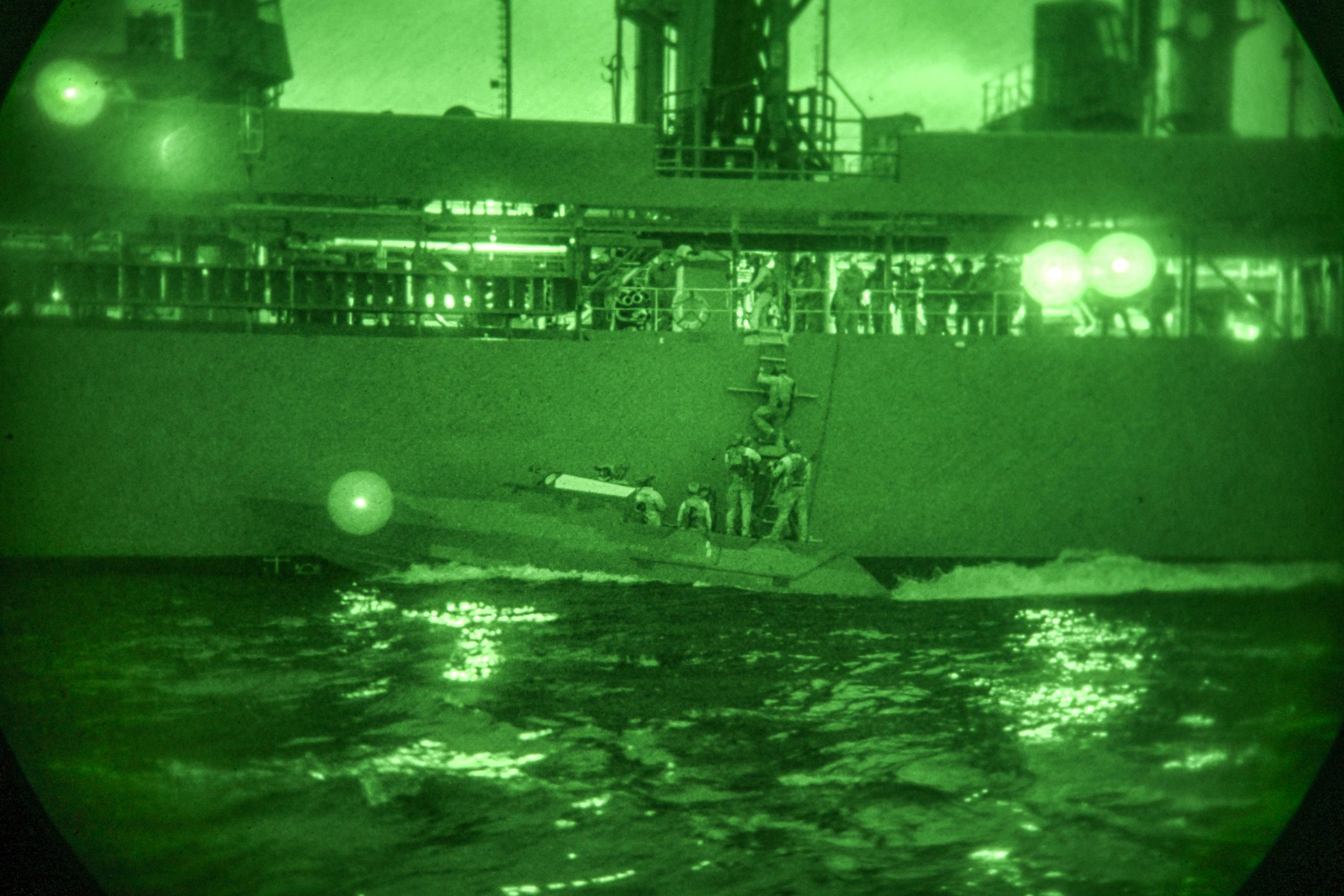
Operators board fleet replenishment oiler USNS Pecos (T-AO 197) during nighttime maritime interdiction operations training off the coast of southern California.
This week, we explore Maduro’s lessons for the Arctic through:
- The Big Picture: Lifeline or Liability?
- From the Field: Power Starts with Presence
- By the Numbers: Know Your Operating Environment
The Big Picture
Lifeline or Liability?
The capture of Venezuelan leader Nicolás Maduro marked the apex of a yearlong pressure campaign which began as a U.S. Navy “hybrid fleet” operation. Honing in on narcotrafficking and illicit oil shipments as the “primary economic lifeline” of the Venezuelan regime, the U.S. carried out targeted strikes and a “total and complete blockade” before capturing Maduro in Operation Absolute Resolve. Ultimately, the economic “lifeline” of the oil tanker shadow fleet became a liability as the U.S. amassed forces in the Caribbean ahead of his capture.
U.S. pressure forced one tanker bound for Venezuela to change its name, reflag to Russia, and flee North towards Russian waters. While Russian-flagged shadow vessels have faced similar international pressure, Russia has an escape hatch: the Arctic. The Arctic waters of the Northern Sea Route (NSR) pose a tantalizing alternative to contested shipping routes, especially as Russia weighs the risk of confrontations with its shadow fleet. For now, Russian control of the Northern Sea Route represents a lifeline by enabling sanctions evasion. 2026 could bring Russia to an inflection point, though, as allied presence in the Arctic increases and Russia weighs the cost of war in Ukraine against its capacity to exert maritime sovereignty over the NSR.
The allure of an Arctic backdoor has attracted attention in North America, too. The Northwest Passage (NWP) forms North America’s own alternative to congested and at times contested chokepoints to the South. Canada plans to bolster its claims of sovereignty over the NWP via regional investment and enhanced defense integration, including a $1 billion Arctic Infrastructure Fund and the reorganization of the Canadian Coast Guard under the Ministry of Defence.
From the Field

U.S. Coast Guard Cutters Healy, Storis, and Polar Star moor at Coast Guard Base Seattle.
Power Starts with Presence
As U.S. forces took to the air for Operation Absolute Resolve, the armada of ships off the coast of Venezuela became more than a tool of economic coercion. They became a power projection platform.
With the U.S. racing to meet opportunity with capability in the Arctic, ice-hardened vessels provide presence throughout U.S. and international Arctic waters. At the end of 2025, the U.S. Coast Guard awarded contracts to build up to six medium polar icebreakers, as authorized under the One Big Beautiful Bill Act. While the domestically built vessels should be delivered in 2029, the U.S. has capitalized on Finnish expertise to accelerate the delivery of up to two icebreakers built overseas. This partnership, advanced by the trilateral ICE PACT Agreement, provides an opportunity for “on-shoring” of specialized shipbuilding expertise and aims to restore the U.S. maritime industrial base in the long term.
The new contracts come on the heels of the newest U.S. icebreaker’s first patrol. Commissioned in August, the Storis came face-to-face with Chinese vessels of the coast of Alaska a mere month later, underscoring the urgency of American maritime presence in the Arctic.
By the Numbers
Know Your Operating Environment
Operation Absolute Resolve hinged on perfect weather conditions to enable the helicopter sortie to reach Maduro’s compound. In densely populated areas like Caracas, operators can count on a high level of domain awareness. In much of the Arctic, it’s a different story.
Sparse infrastructure and lower population densities limit domain awareness in the Arctic but understanding the harsh Northern operating environment is a prerequisite for mission success in the region. NOAA’s annual Arctic Report Card has monitored the region’s vital signs for the last 20 years, providing the information needed to plan and execute missions in the Arctic.
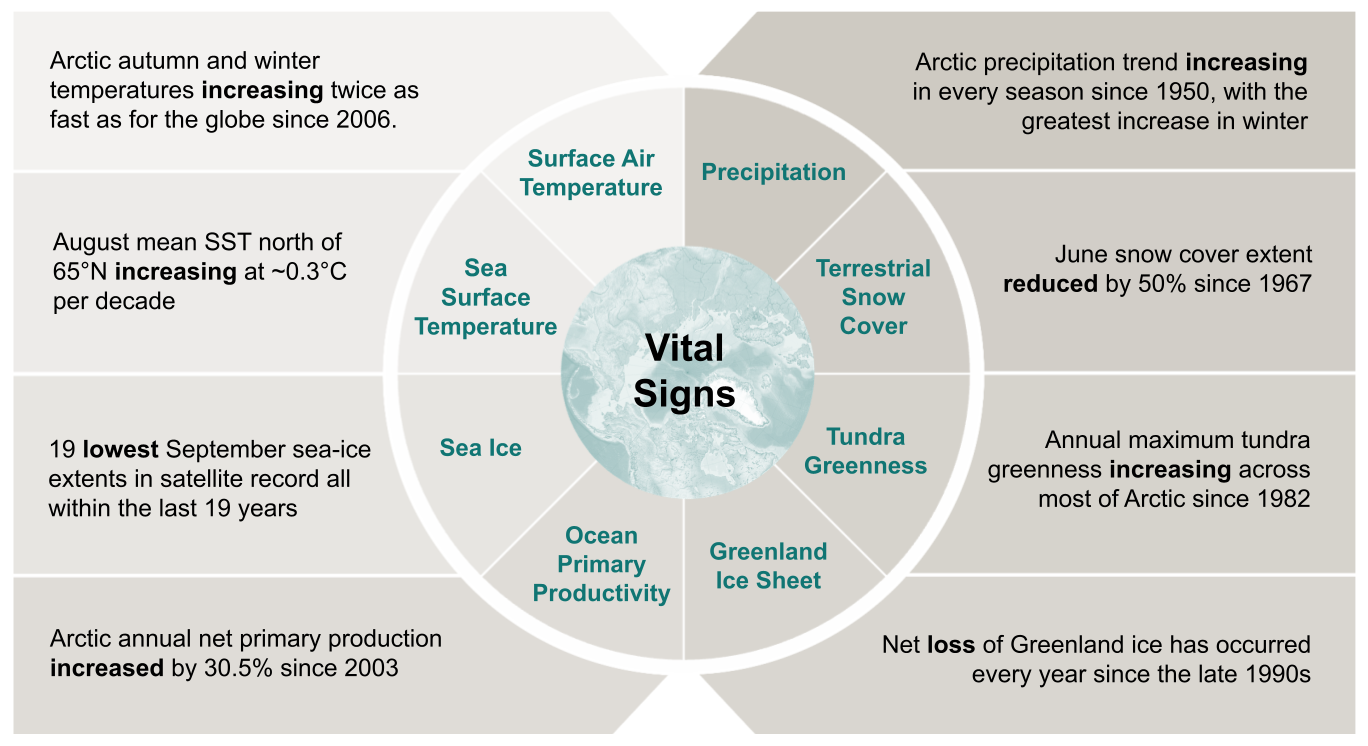
The eight vital signs from NOAA’s 2025 Arctic Report Card.

Any views expressed in this newsletter do not reflect the offical policy or position of the Ted Stevens Center, Department of War (DoW), or the U.S. Government. The appearance of external hyperlinks does not constitute endorsement by the DoW of the linked websites or the information, products, or services contained therein. DoW does not exercise any editorial, security, or other control over the information you may find at these sites.