
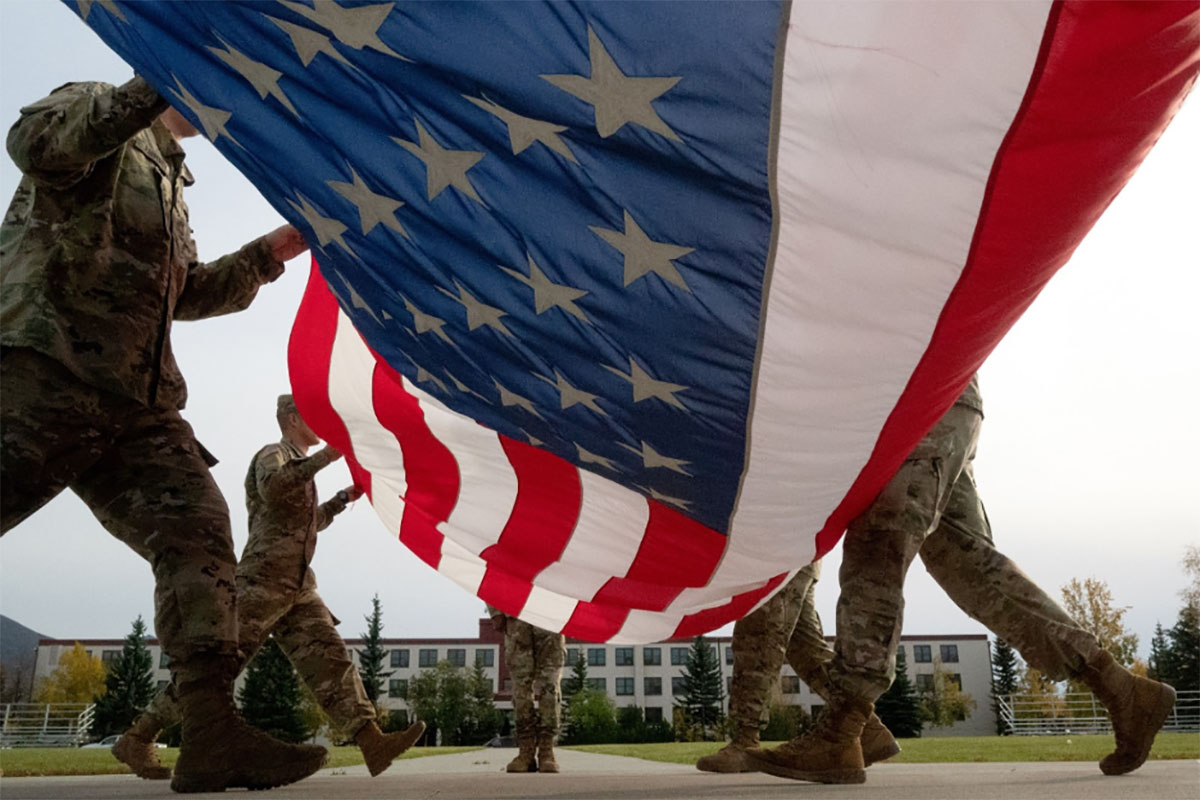
Soldiers fold the American flag while performing the daily flag retirement detail on Joint Base Elmendorf-Richardson, Alaska, Sept. 26, 2018.
This week, we explore NATO’s Arctic fighting force through:
- The Big Picture: American Sovereignty & the Arctic
- Lat & Long: Defining the U.S. Arctic
- On the Hill: Arctic Security and Diplomacy Bill
The Big Picture
The Summit & The Arctic
American Sovereignty & the Arctic
Across the United States this week, Americans will celebrate 250 years of American sovereignty since the signing of the Declaration of Independence. Not until nearly a century later, though, did the U.S. become an Arctic nation with the Alaska Purchase in 1867. Russia formally transferred the Alaskan territory to U.S. control, but credible American sovereignty in the Arctic would take more than the stroke of a pen.
In the centuries following purchase, Alaska’s abundant natural resources and geostrategic importance would overcome skepticism about “Seward’s Folly” and push to enhance American sovereignty over its Arctic territory. That push continues today, with major investments in Alaskan military infrastructure and presence under the banner of top-level strategic guidance to “unapologetically protect our own sovereignty” in the Western Hemisphere, including the Arctic. The Coast Guard, Air Force, and National Guard have each been the subject of recent investment proposals, exemplifying the modern approach to American Arctic sovereignty.
Generational investments in the U.S. Coast Guard have advanced design, production, and deployment of a specialized instrument of sovereignty in Arctic waters: the icebreaker. While construction for the first of 11 Arctic Security Cutters (ASC) has begun in Finland, the vessel will find a home in Alaska upon commissioning. The Coast Guard will homeport two ASCs in Kodiak, with a third destined for Seward on top of the USCGC Storis in Juneau.
Sovereignty in the skies depends on aircraft intercepting incursions in America’s Arctic airspace. According to the Air Force, the supporting infrastructure for these planes needs work. The Fightertown Recapitalization effort aims to improve aging infrastructure on Joint Base Elmendorf-Richardson (JBER) and could total roughly $7 billion in investment.
Sparse infrastructure and vast distances characterize the North American Arctic as a whole and Alaska specifically, challenging military logistics in the region. Senator Dan Sullivan’s (R-AK) Alaska National Guard Rural Community Revival Act aims to alleviate this challenge by strengthening local resources. The Act’s six pillars aim to modernize infrastructure, create logistical hubs, incentivize rural recruiting and retention, upgrade technological systems, expand dual-use airfields, and promote public-private partnerships.
Taken together, these initiatives and others emphasize the relevance of Alaska not just as the America’s Arctic foothold, nor simply a frontier of homeland defense. The 49th state is the homeland. As the nation celebrates its 250th Independence Day, policymakers and practitioners across the government recognize that credible American presence in Alaska will make a difference in the years to come.
Lat & Long
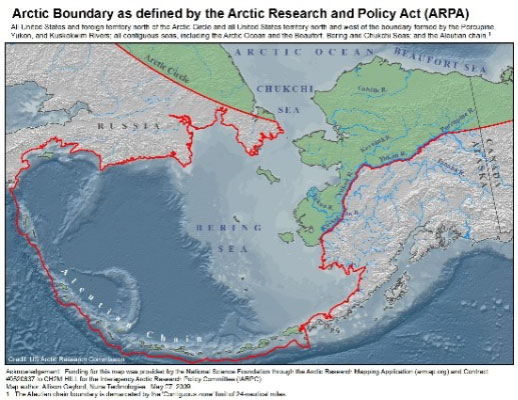
Source: U.S. Arctic Research Commission.
Defining the U.S. Arctic
To understand America’s Arctic, you first need to define the Arctic. By one definition, the Arctic encompasses all territory above the Arctic Circle, where the sun does not set on the summer solstice nor rise at the winter solstice. Other definitions rely on ecological characteristics, such as the tree line or average temperatures. For the U.S. government, though, the Arctic includes territory north of the Arctic Circle “and all United States territory north and west of the boundary formed by the Porcupine, Yukon, and Kuskokwim Rivers; all contiguous seas, including the Arctic Ocean and the Beaufort, Bering, and Chukchi Seas; and the Aleutian chain.” As the map shows, this definition established in the Arctic Research and Policy Act includes a swath of Alaska and the Bering Sea that falls south of the Arctic Circle.
On the Hill
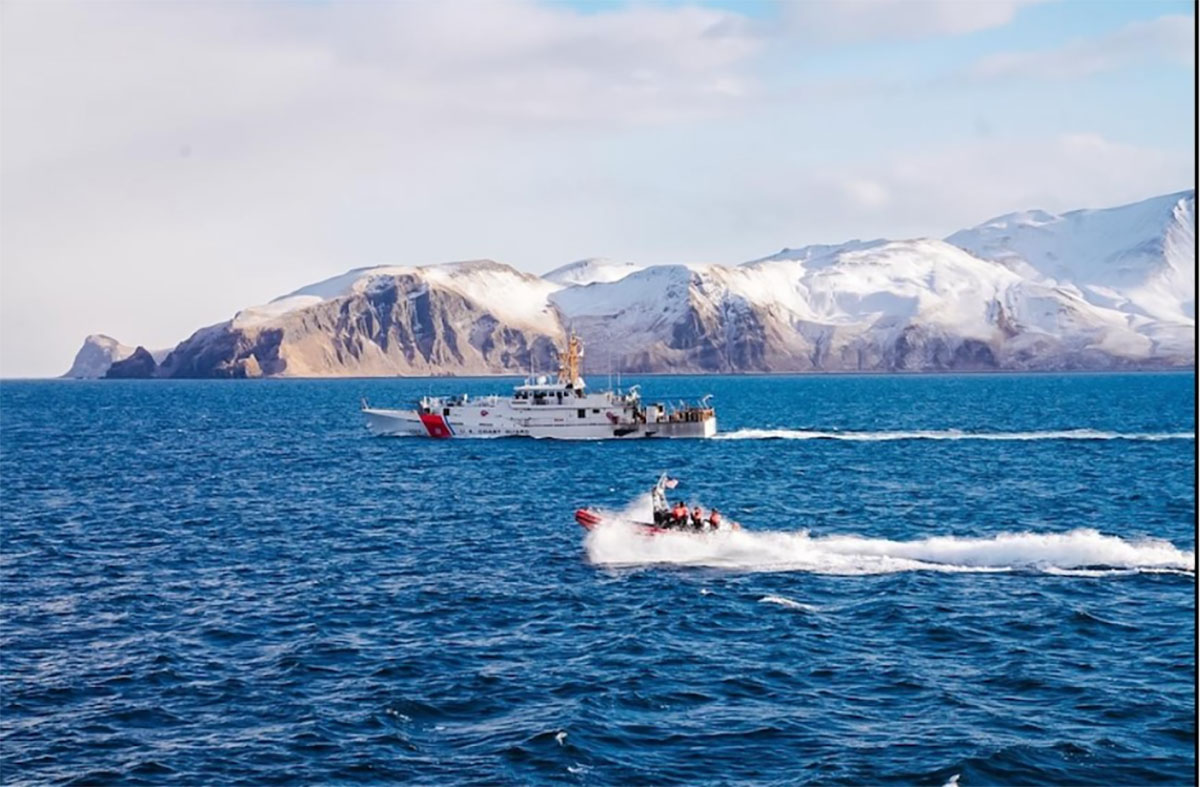
Coast Guard Cutters Stratton and Bailey Barco rendezvous near Dutch Harbor, Unalaska, while on patrol for fisheries enforcement, safety of life at sea, and sovereignty projection in 2024.
Arctic Security and Diplomacy Act
The U.S. Arctic is the subject of a recent bipartisan bill introduced by Senators Mike Lee (R-UT) and Jeanne Shaheen (D-NH), the Arctic Security and Diplomacy Act. The past several years have seen an increasing and unprecedented number of Russian, Chinese, and joint Russo-Chinese operations off Alaska’s coast. The presence of foreign scientific research vessels has raised concerns about dual-use research, a risk the bill aims to address. According to Senator Lee, “this legislation shuts the door to foreign adversaries attempting to commit espionage and exercise influence at our doorstep in the Arctic… from the Aleutians to the Beaufort Sea.” The bill specifically calls for a State Department-led strategy to identify, deter, and counter foreign espionage, influence campaigns, and intelligence-gathering operations within U.S. Arctic waters. The Senate Foreign Relations Committee has advanced the Arctic Security and Diplomacy Act. Before becoming law, however, the bill must also pass the full Senate and House of Representatives.
That’s all for now. Stay tuned for the next update. In the meantime, follow the TSC on LinkedIn or check us out online.

Any views expressed in this newsletter do not reflect the offical policy or position of the Ted Stevens Center, Department of War (DoW), or the U.S. Government. The appearance of external hyperlinks does not constitute endorsement by the DoW of the linked websites or the information, products, or services contained therein. DoW does not exercise any editorial, security, or other control over the information you may find at these sites.