
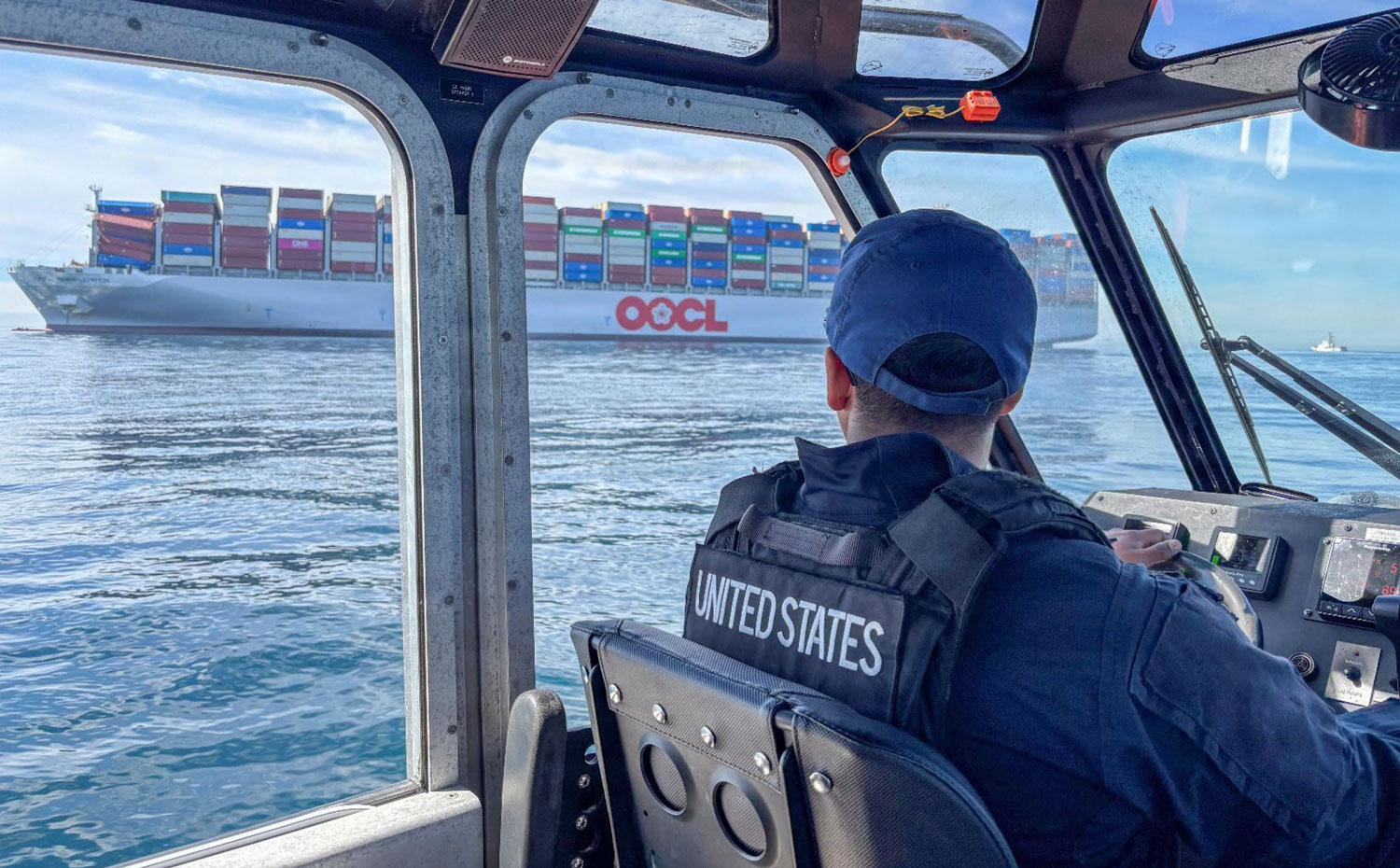
U.S. Coast Guard Petty Officer 3rd Class Jacob Padilla enforces a safety zone after container ship M/V OOCL Sunflower lost 32 shipping containers overboard on March 3, while transiting south of the Aleutian Island Chain en route to the Port of Long Beach, California.
This week, we explore how economics and defense converge in the Arctic-Pacific through:
- The Big Picture: Flag & Trade
- This Week in History: Operation Landcrab
- By the Numbers: Arctic-Pacific Energy
The Big Picture
Flag & Trade
In the Arctic-Pacific, does the flag follow trade or vice versa?
Last July’s Arctic Security Update introduced the players and the game in the Arctic-Pacific. This installment takes a closer look at how economic security and defense priorities converge in the ArcticPacific.
The U.S. and Canada maintain long-standing defense commitments in the Arctic-Pacific. The region is a critical component of North American homeland defense and a key area for monitoring strategic approaches. In response, both countries have announced significant investments in the North to strengthen presence, enhance domain awareness, and improve response capabilities.
This partnership is anchored in their binational leadership of North American Aerospace Defense Command (NORAD), an enduring model of allied defense cooperation. As attention on the Arctic Pacific grows, both nations are investing in a maritime region that has not yet seen sustained levels of traffic – prioritizing presence and reinforcing sovereignty. Whether trade will follow the flag remains to be seen. For partners and allies on the other side of the Pacific, the question is whether security engagement will keep pace with expanding economic interests. Increasingly, these nations are focused on protecting those interests through contributions to regional security and stability. Scientific collaboration and commercial activity have drawn several Indo-Pacific nations to the Arctic. The Republic of Korea, for example, commissioned its first icebreaker in 2009 and has examined Arctic shipping routes over a decade. Disruptions to global energy markets have reinforced the potential value of shorter transit times and more diversified supply chains.
While economic engagement is well established, security contributions remain more targeted and continue to evolve, often centered on maritime coordination, domain awareness, and governance frameworks rather than sustained presence. Alongside Japan, the Republic of Korea participates in regional maritime forums such as the North Pacific Coast Guard Forum and is a signatory to the Central Arctic Ocean Fisheries Agreement.
At the same time, China and Russia continue to pursue their own interests in the Arctic-Pacific, expanding presence through research, infrastructure, and maritime activity in ways that increasingly intersect with regional security considerations.
Last week, the Ted Stevens Center hosted a forum dedicated to this topic—the Arctic-Pacific Security Dialogue. Speakers from across the Arctic-Pacific including the U.S., Canada, the Republic of Korea,
Japan and Australia examined maritime security challenges in the context of a more accessible Arctic
Ocean. While international security cooperation in the Arctic Pacific continues to strengthen, across the Arctic there is a “growing geopolitical consensus that economic security is national security and national security is economic security.”
This Week in History
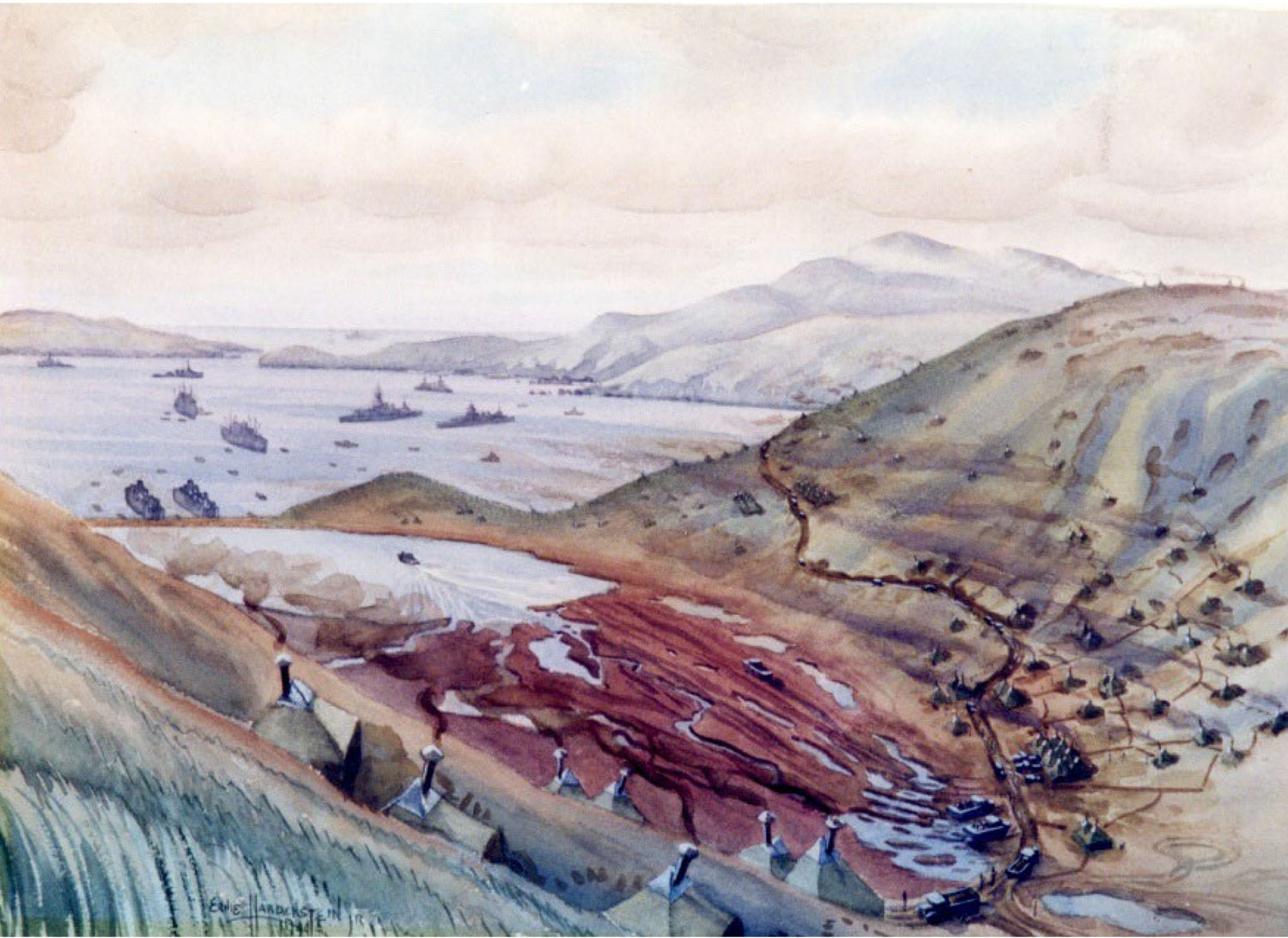
This Ernie Hardenstein watercolor shows that few harbors, runways, or even roads existed in most of the Aleutian Islands during World War II so amphibious operations were needed to resupply American and Canadian troops.
Operation Landcrab
83 years ago, U.S. and Canadian forces prepared to launch “Operation Landcrab,” the campaign to retake Attu Island. While Japanese attacks on the Aleutians were frequently described as a diversion from the main Japanese operation at Midway, the Japanese occupation of the islands was in fact a “complementary operation… in order to prevent the United States from using them as a base to attack Japan from the north.” Allied troops successfully reclaimed Attu, ending the only time Axis forces occupied U.S. soil during World War II and highlighting the Aleutian Islands’ enduring strategic importance. Today, focus has shifted toward Adak Island. The U.S. Department of War and Congress have established a landmark partnership between the Denali Commission and U.S. Navy to strengthen critical infrastructure on this “unrivaled strategic terrain,” backed by up to $115 million in funding.
This effort aligns with a parallel move by the U.S. Coast Guard’s decision to homeport its first two Arctic Security Cutters in Alaska. With delivery expected in 2028, the Coast Guard is already planning the infrastructure needed to support these vessels and their operations, though the exact homeport location has not yet been announced. Together, these investments signal a coordinated push to expand U.S. presence in the Arctic-Pacific, reinforcing the region’s enduring strategic importance throughout history.
By the Numbers
Arctic-Pacific Energy
Global energy market disruptions in Russia and Iran have renewed discussion on U.S. gas development, with possible implications for the Arctic-Pacific. The U.S., Canada, and Russia are major natural gas suppliers while Indo-Pacific countries like China, Japan, India and the Republic of Korea rank among the top consumers. Around the world, countries are re-assessing their energy supply chains. The energy market has become a topic of conversation not just among economists, but also security and defense practitioners.
On April 20, U.S. President Donald Trump invoked the Defense Production Act (DPA) to “expand domestic natural gas transmission, processing, storage, and LNG capacity.” The DPA gives the president authorities to bridge the gap between private industry and defense requirements – in this case, President Trump stated that “ensuring sufficient natural gas and liquefied natural gas (LNG) capacity is critical to sustaining United States defense operations and ensuring allied energy security.”
At the same time, Alaska’s legislature is weighing legislation that could advance a proposed 800-mile liquefied natural gas pipeline from Prudhoe Bay to the Kenai Peninsula. Alaska’s proposed pipeline, as well as the geopolitics shaping the global market, could shape the Arctic-Pacific of tomorrow.
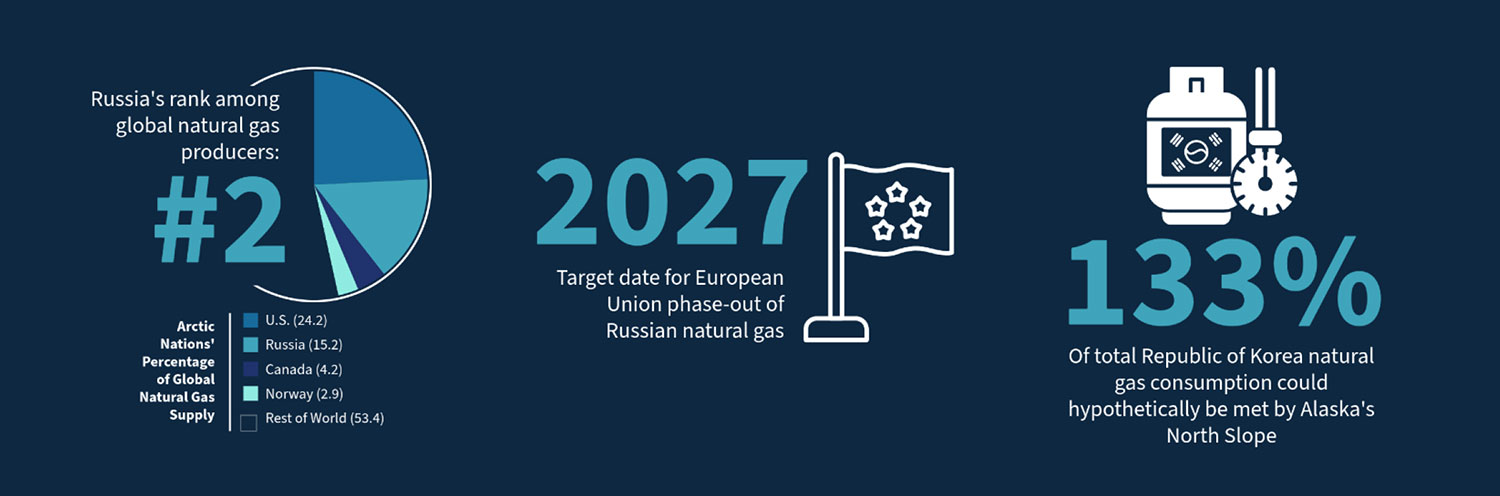
Sources: Energy Information Administration and European Commission.

Any views expressed in this newsletter do not reflect the offical policy or position of the Ted Stevens Center, Department of War (DoW), or the U.S. Government. The appearance of external hyperlinks does not constitute endorsement by the DoW of the linked websites or the information, products, or services contained therein. DoW does not exercise any editorial, security, or other control over the information you may find at these sites.