

U.S. Marine Corps Personnel ski up Green Hill during Exercise Cold Response 26 in Setermoen, Norway on January 29, 2026.
This week, we explore NATO’s Arctic moment through:
- The Big Picture: Arctic Sentry
- From the Field: The Arctic Drone Laboratory
- From the Oval Office: Maritime Action Plan
The Big Picture
Arctic Sentry
After much anticipation, NATO has announced its next move in the North: Arctic Sentry. This new multi-domain activity led by Joint Force Command Norfolk aims to strengthen NATO’s northern posture in response to Chinese and Russian activities in the region. Arctic Sentry mirrors similar so-called enhanced Vigilance Activities (eVA) in NATO’s East: Baltic Sentry and Eastern Sentry.
According to NATO Secretary General Mark Rutte, Arctic Sentry will enhance the coordination of existing allied operations and activities. These activities include the recently concluded Exercise Arctic Dolphin, which focused on anti-submarine warfare training and upcoming Exercise Cold Response, which will test allied defense capabilities sin Norway. This strategic move toward greater cohesion follows discussions between U.S. President Donald Trump and Secretary General Rutte regarding the alliance’s defensive responsibilities in the Arctic. The 2026 U.S. National Defense Strategy identifies Russia as a “persistent but manageable threat” and underscores the need for greater allied burden-sharing to counter the threat. “We are doing this together,” Rutte emphasized, highlighting Arctic Sentry as a prime example of effective burden-sharing in ensuring Arctic security.
To further increase European responsibility, NATO has implemented structural changes within its command. Earlier this month, the alliance confirmed that leadership of Joint Force Command (JFC) Norfolk and JFC Naples would be transferred from the U.S. to the United Kingdom and Italy, respectively. In return, the U.S. will assume control of Allied Maritime Command, bringing the three core theater component commands (land, air, and sea) under its leadership. The alliance will implement the changes gradually over the next few years.
While NATO bolsters European-led security efforts in the Arctic, the U.S. and Canada continue to strengthen their partnership in defending North America. U.S. General Gregory Guillot, Commander of North American Aerospace Defense Command (NORAD), has highlighted coordination efforts on key issues like the “Golden Dome” missile defense shield, Arctic energy supply, and counter-drone technology development. The U.S. and Canada face mutual threats in the North American Arctic, including increased joint activities between Russia and China. The initiation of Arctic Sentry alongside NORAD’s continued strengthening signal a clear and growing trend toward a more integrated international allied approach to security across the Arctic.
From the Field
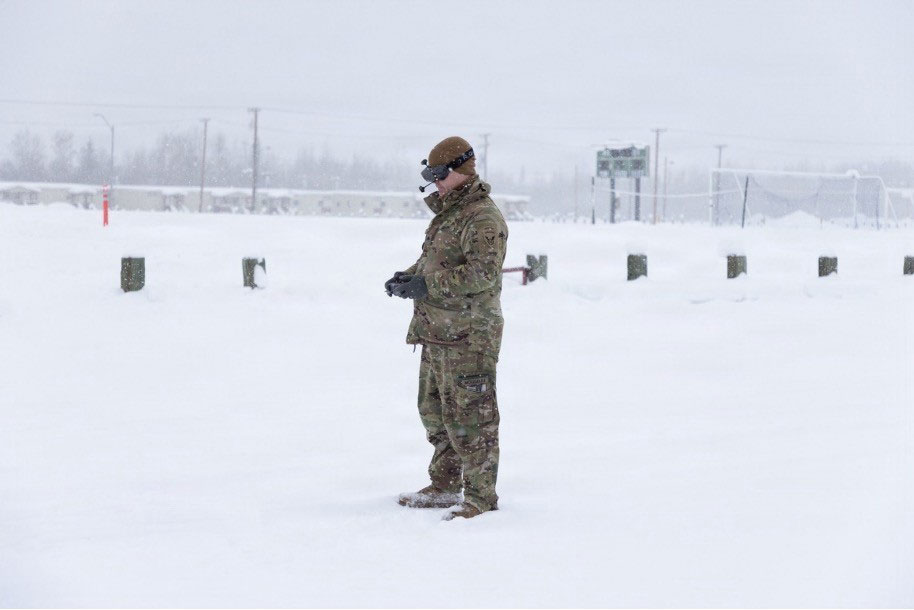
A U.S. Army lSoldier assigned to the 11th Airborne Division gives an FPV drone demonstration during Joint Pacific Multinational Readiness Center 26-02 at Fort Wainwright, Alaska, Feb. 14, 2026.
The Arctic Drone Laboratory
In addition to outlining the threats NORAD confronts in the Arctic, Gen. Guillot touched on the command’s efforts testing counter drone technology in the Arctic’s real-world laboratory. The 11th Airborne Division has played a leading role in testing and experimentation. Exercises last November assessed system performance in extreme cold. This month during Joint Pacific Multinational Readiness Center (JPMRC) 26-02 the 11th will execute the largest Arctic test of small unmanned aerial systems (UAS) to date. In addition to assessing performance in cold temperatures, the exercise will evaluate battery life and visibility in darkness for first-person view drones.
U.S. drone and counter-drone initiatives support the broder NATO effort to enhance UAS preparedness. Reflecting during January’s NATO C-UAS week, Secretary General Mark Rutte highlighted the number one lesson learned from Ukraine: “drones are here to stay.” Allied forces are already putting drones to work in the Arctic. The Danish Air Force established the 729 Squadron this week, tasked with “monitoring and surveillance in the Arctic and Greenland” using four MQ-9B Sea Guardian drones. Successful integration of remotely-piloted aircraft into Arctic operations demonstrates allied advances from the laboratory to field deployment.
From the Oval Office
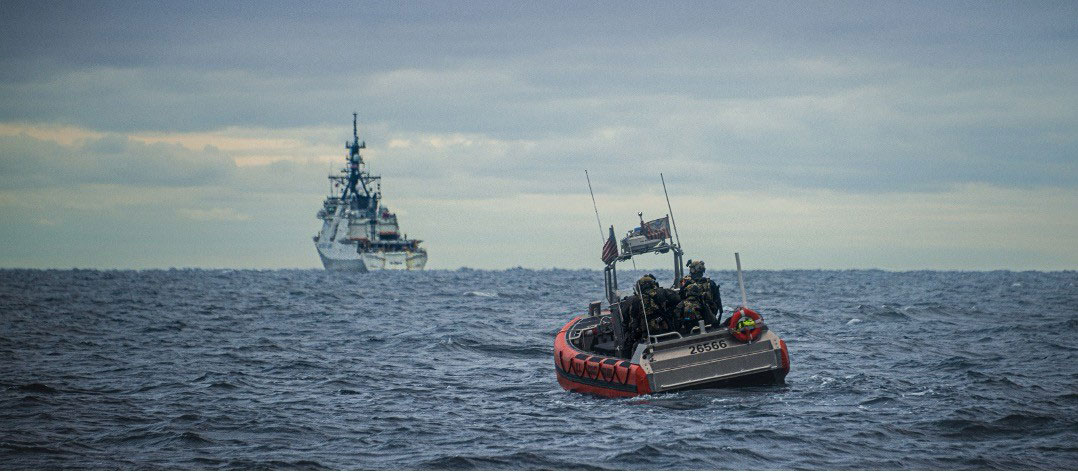
Members of Coast Guard Maritime Security Response Team West, USCGC Waesche (751), and Special Operations Forces transit on an Over the Horizon cutter boat during Arctic Edge 2025 near Nome, Alaska.
Maritime Action Plan
Unmanned systems are not just for the air—the newly released America’s Maritime Action Plan (MAP) prioritizes robotic and autonomous maritime systems to aid in improving Arctic domain awareness. The guidance on unmanned systems comes as part of two and half pages of recommended policy to advance the Arctic Waterways Security Strategy. The document addresses a wide range of maritime issues, from growing the investment and the shipbuilding workforce to ensuring freedom of navigation. When it comes to the trans-Atlantic partnership, the MAP emphasizes the need to empower European Arctic allies in the High North, “while the United States secures the North American Arctic along with Canada.”

Any views expressed in this newsletter do not reflect the offical policy or position of the Ted Stevens Center, Department of War (DoW), or the U.S. Government. The appearance of external hyperlinks does not constitute endorsement by the DoW of the linked websites or the information, products, or services contained therein. DoW does not exercise any editorial, security, or other control over the information you may find at these sites.