
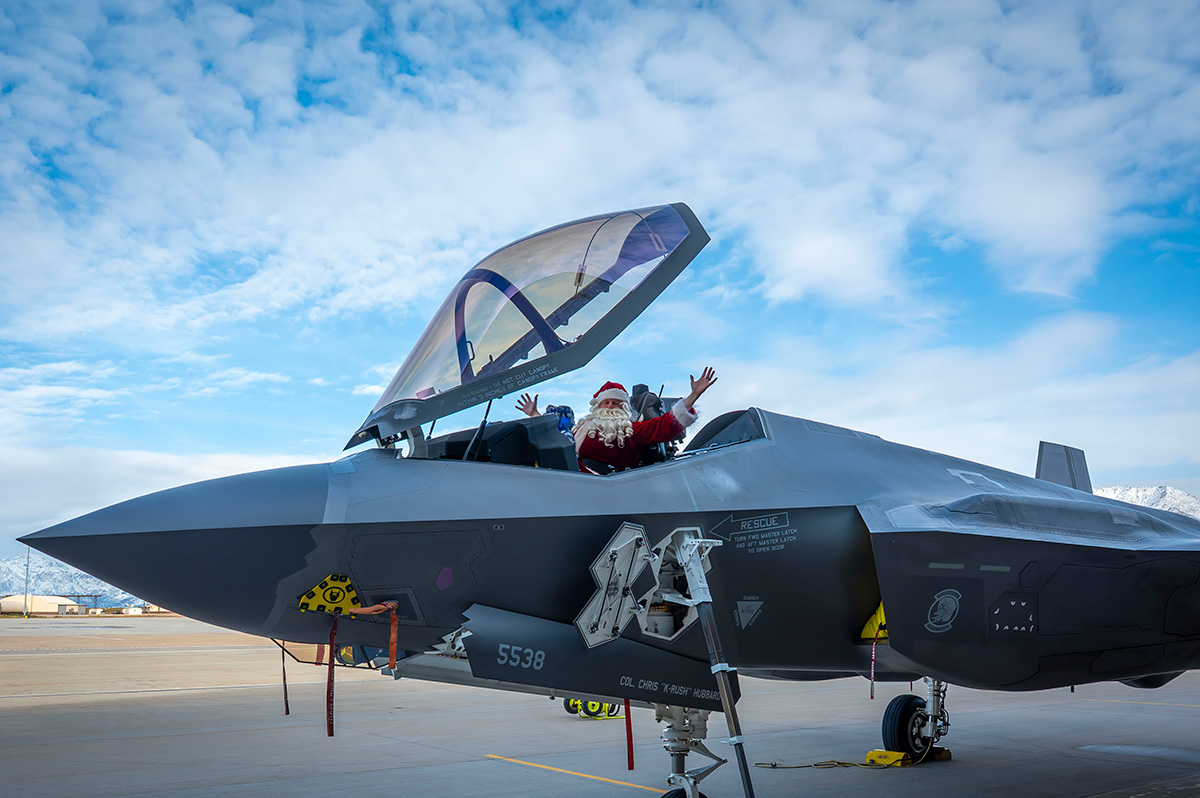
Santa arrives in an F-35A Lightning II at the 419th Fighter Wing Family Holiday Party, Dec. 7, 2025, at Hill Air Force Base, Utah
This week, we explore how U.S. Arctic security policy is built through:
- The Big Picture: American Alliances from Arabia to the Arctic
- From the Field: U.S. Army Activates Western Hemisphere Command
- From the Diplomatic Desk: U.S.-Greenland Joint Committee
The Big Picture
What Washington Wants
Just in time to mail to Santa, the newly released National Security Strategy (NSS) outlines Washington’s wish list, asking on page 3, “What Should the United States Want?” Congress answered shortly afterward with what the United States will get, as outlined in the final text of the National Defense Authorization Act (NDAA).
Keen Arctic observers may have searched the NSS for mentions of the Arctic, only to be disappointed. However, while the Pentagon develops U.S. national security policy from the top down, this doesn’t mean starting from the North Pole. Top-down policy development means the NSS kicks off a multi-step process to create Arctic security policy. Following the NSS, the National Defense Strategy will translate strategic priorities into actionable directives. Subsequent strategic documents may further detail how Washington can get what it wants in the Arctic.
Without naming the Arctic, the NSS clearly lays out what the U.S. wants starting with the Western Hemisphere. The NSS advances concepts of the of the Monroe Doctrine, envisioning a unified theater within the U.S. sphere of influence. Included in this theater are the North American Arctics of Greenland, Canada, and Alaska. The NSS calls for re-allocating military presence toward “urgent threats” on land and at sea in near the homeland, as well as enhancing access to “strategically important locations.” As one of the most strategically important locations on Earth, this reorientation will likely look toward America’s Arctic.
Turning to the Indo-Pacific, the NSS identifies the region as home to “the next century’s key economic and geopolitical battlegrounds.” U.S. allies in the region recognize the importance of the Arctic-Pacific and are working to advance international cooperation. One example begins today: the Korean Ministry of Foreign Affairs’ tenth annual Arctic Partnership Week.
Not to be forgotten, the NSS also sets out priorities for Europe, focusing on increased burden sharing and Russia. The war with Ukraine pulled resources and attention from Russia’s Arctic forces and brought international collaboration to a standstill. An end to the war could both reignite Russia’s Arctic militarization and re-open opportunities for cooperation. While talks commenced this week, annual Norwegian–Russian fisheries negotiations faced challenges following Norway’s recent sanctions.
From the Field

The new U.S. Army Western Hemisphere Command patch approved by The Institute of Heraldry effective Nov. 20, 2025, is displayed at the USAWHC activation and Transition of Command ceremony.
U.S. Army Activates Western Hemisphere Command
Throughout 2025, Department of War restructurings have solidified the Arctic’s place in the homeland defense mission. Back in June, Greenland moved from U.S. European Command to U.S. Northern Command’s jurisdiction. More recently on Dec. 5, the U.S. Army combined U.S. Army Forces Command, U.S. Army North, and U.S. Army South into a unified Western Hemisphere Command. The restructuring marked the latest move in the Army Transformation Initiative, launched earlier this year. The new command will support both U.S. Northern Command and U.S. Southern Command, streamlining the organization while increasing coordination of homeland defense. With nearly 3,000 miles separating Alaska from Washington, D.C., America’s Arctic has at times been viewed as a peripheral territory. Today, more than ever, the Arctic is the frontline of homeland defense.
From the Diplomatic Desk
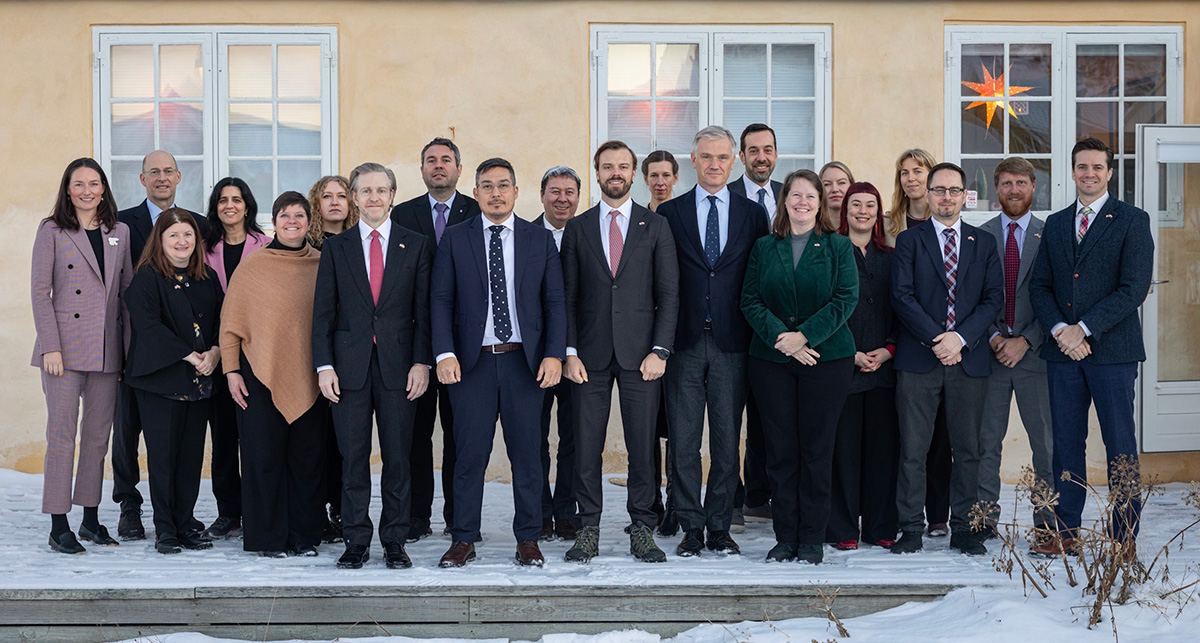
Group photo from the 2025 Joint Committee meeting in Nuuk.
U.S.-Greenland Joint Committee
Along with U.S. national security goals, the NSS also laid out a roadmap for how to achieve those goals. The tools at hand listed in the document include “a broad network of alliances, with treaty allies and partners in the world’s most strategically important regions,” including the Arctic. This week, the U.S. delegation met with partners in Greenland to advance a strategically vital collaboration.
U.S. Ambassador to Denmark, Kenneth Howery, made his first trip to Greenland this week to join the annual convening of the U.S. Greenland Joint Committee. Established in 2004, the Joint Committee seeks to strengthen cooperation to “support a secure and prosperous Arctic region.” The specific topics covered by the committee include economics, energy, and natural resources. The Joint Committee includes representatives from both the Greenland Home Rule Government and the Kingdom of Denmark, providing an opportunity to build on the longstanding U.S. partnership with Greenland under the framework of the broader NATO alliance.
Any views expressed in this newsletter do not reflect the offical policy or position of the Ted Stevens Center, Department of War (DoW), or the U.S. Government. The appearance of external hyperlinks does not constitute endorsement by the DoW of the linked websites or the information, products, or services contained therein. DoW does not exercise any editorial, security, or other control over the information you may find at these sites.